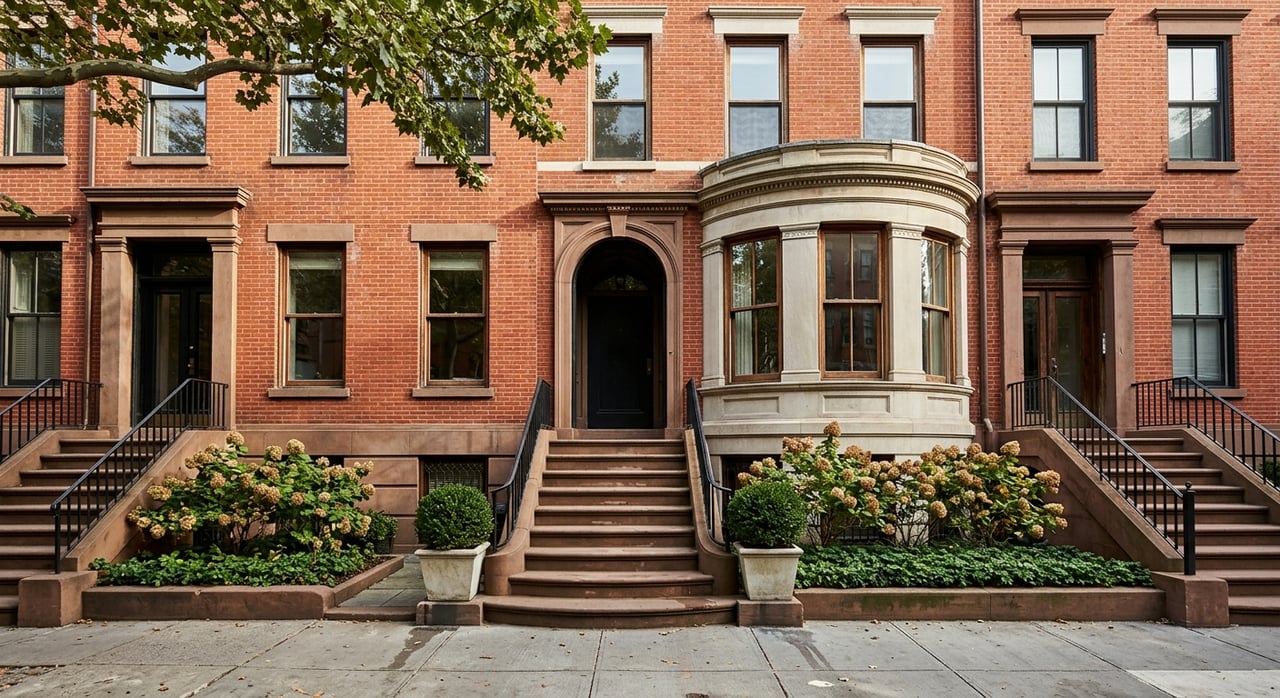
Wondering whether you should sell your Brooklyn townhouse quietly or launch it everywhere at once? It is a fair question, especially in a market where privacy, timing, and price can pull you in different directions. If you are weighing an off-market strategy against a public listing, the right answer depends on your goals, your townhouse, and how Brooklyn’s current rules and market conditions actually work. Let’s dive in.
Brooklyn townhouse sellers face a real choice
Brooklyn remains a strong market, but it is not a simple one. In Q3 2025, the borough’s median sales price topped $1 million, inventory rose 16.3% year over year to 3,417 homes, and 22% of sales closed over asking, according to Brownstoner’s summary of Douglas Elliman and Miller Samuel data. At the same time, StreetEasy’s December 2025 snapshot showed 3,434 homes for sale in Brooklyn, with a median asking price of $1,017,500 and a median of 73 days on market.
That mix matters if you own a townhouse. Buyers still compete for the right property, but they also have more choices than they did in tighter inventory periods. That means your sale strategy, not just your asking price, can shape the outcome.
What off-market means in Brooklyn
In New York City, “off-market” sounds straightforward, but it is not the most precise term. REBNY says it can be misleading to describe an exclusive listing that way, even if the owner has opted out of the Residential Listing Service.
In practice, more accurate terms are owner opt-out, office exclusive, or delayed marketing. Those labels better reflect how a listing is being handled and help avoid confusion about what can and cannot happen before a home is broadly marketed.
Brooklyn rules matter more than many sellers expect
If you are thinking about a quiet launch, the rules matter. REBNY’s RLS covers all five boroughs, including Brooklyn, and the practical standard is simple: once an exclusive listing is publicly disseminated or shown to any buyer, it must be entered into the RLS, whichever happens first.
Public dissemination is broad. REBNY includes public websites, social media, and third-party consumer portals in that definition. So if your goal is a truly private or tightly controlled pre-market period, the details of how your home is discussed and shared are important.
Can you market to a few brokers first?
Yes, but only within a narrow lane. NAR’s 2025 policy update says one-to-one broker-to-broker communication does not trigger Clear Cooperation, and REBNY allows limited communication before broader public dissemination.
That means a seller can sometimes begin with a very targeted, private conversation strategy. But that is different from widely promoting the townhouse while trying to keep it “off-market.” Once the effort crosses into public marketing, the listing rules change.
Why many Brooklyn townhouses do best on market
If your priority is price discovery, broad exposure usually gives you the strongest shot. That is especially true when your townhouse is show-ready, well-styled, and likely to appeal to a wide pool of buyers.
The current Brooklyn market still supports competition. With 22% of borough sales closing over asking in Q3 2025, a polished public launch can create urgency and bring multiple buyers into the conversation.
For a townhouse, that visibility matters. Architecture, light, layout, outdoor space, and block-level location can all be emotional drivers, and the more qualified buyers who see the home, the better your odds of surfacing the strongest terms.
The tradeoff is privacy versus competition
A private or delayed-marketing route can make sense if discretion is your top priority. NAR notes that some sellers choose delayed marketing for privacy and other personal reasons.
That can be valuable if you want fewer showings, a more controlled rollout, or a brief period to test interest before a wider launch. For some townhouse sellers, that lower-profile approach feels more manageable.
But there is a tradeoff. Zillow’s 2025 research found that off-MLS homes sold for a median of $4,975 less nationally, and in New York, sellers who sold off-MLS had a median loss of 3.7%, or $13,749. The negative effect was smaller in the luxury tier, but it was still negative.
Why neighborhood price band changes the answer
Not every Brooklyn townhouse should be marketed the same way. Pricing in the borough is highly neighborhood-specific, and that changes the risk and reward of a private versus public strategy.
According to Brown Harris Stevens’ Brooklyn townhouse report, Boerum Hill, Brooklyn Heights, Carroll Gardens, Cobble Hill, and DUMBO averaged $4.78 million in H1 2025 and $4.93 million in H2 2025. Park Slope, South Slope, and Windsor Terrace averaged $3.18 million and $3.48 million over those same periods, while Brooklyn’s broader 1 to 3 family home segment averaged $1.54 million in H1 2025 and $1.60 million in H2 2025.
That tells you something important. A highly distinctive townhouse in a prime brownstone corridor may attract serious buyers even through a discreet rollout, especially if there is already credible buyer interest. A more broadly appealing townhouse in a wider price band may benefit more from full-market competition, because the buyer pool is larger and broader exposure can make a bigger difference.
When on-market usually makes more sense
For many Brooklyn townhouse sellers, a public launch is the stronger move when:
- Your home is show-ready and photographs well
- Your goal is to maximize exposure and invite competition
- Your townhouse has broad appeal in layout, condition, or location
- You are in a neighborhood or price band where many buyers are actively comparing options
- You want the market to help validate pricing quickly
This is where thoughtful presentation matters. Strong visuals, polished copy, and a clear pricing strategy often work best when paired with broad visibility, because buyers can discover the home, compare it, and act with confidence.
When a private or delayed launch can work
A private exclusive or delayed-marketing approach may be worth considering when:
- Privacy is a top concern
- You already have credible buyer interest
- You want a tightly managed pre-launch period
- You need a little more time before a broader rollout
- You prefer fewer initial showings while still exploring demand
The key is to go in with clear expectations. A quieter strategy may reduce noise, but it can also reduce leverage if fewer buyers know the townhouse is available.
Can you test quietly and relaunch later?
Yes, but you should not assume that a quiet first phase gives you a clean reset. REBNY’s FAQ makes clear that days on market do not simply disappear because a seller wants them to. The clock generally resets only after a closed sale or 90 consecutive days off market.
So if you plan to start with a private phase and then go public, it is smart to treat that as one coordinated strategy, not two unrelated launches. Timing, pricing, and compliance need to line up from the start.
What should you call it?
Language matters here. In the Brooklyn and REBNY context, calling a listing “off-market” can be too vague.
More accurate terms include:
- Private exclusive
- Office exclusive
- Delayed marketing
- Owner opt-out
Using the right label helps you understand the rules and set the right expectations for how your townhouse will be introduced to buyers.
A smart Brooklyn townhouse strategy starts with your goals
There is no one-size-fits-all answer. If your priority is maximum exposure and the strongest chance at buyer competition, an on-market launch is often the best fit. If your priority is discretion, a carefully managed private or delayed approach may better match your needs, especially for a short pre-launch period or a more specialized buyer pool.
The important thing is to make the decision with current market data, clear rules, and a realistic view of the tradeoffs. In Brooklyn, the difference between a quiet sale and a well-executed public launch can affect not just how your townhouse is seen, but how it is priced, negotiated, and ultimately remembered in the market.
If you are weighing which path makes sense for your Brooklyn townhouse, The Jane Advisory can help you build a strategy that fits your goals, your timeline, and the story your home is ready to tell.
FAQs
What does off-market mean for a Brooklyn townhouse sale?
- In Brooklyn, “off-market” is often too vague. More precise terms include private exclusive, office exclusive, owner opt-out, or delayed marketing, depending on how the listing is handled under REBNY rules.
Is an on-market listing better for Brooklyn townhouse pricing?
- Often, yes. Broad exposure can create more buyer competition, and in Q3 2025, 22% of Brooklyn sales closed over asking, which suggests public launches can still help drive strong outcomes.
Can I share my Brooklyn townhouse with a few brokers before listing it publicly?
- Yes, but only in a limited way. One-to-one broker communication may be allowed before broader public marketing, as long as it stays within current rules.
Do private Brooklyn townhouse sales usually bring lower offers?
- They can. Zillow’s 2025 research found a median price penalty for off-MLS sales nationally and in New York, though the gap was smaller in the luxury tier.
Can I privately test my Brooklyn townhouse sale and then relist it fresh later?
- You can start with a private phase and later go public, but REBNY’s days-on-market rules still matter, so it is not the same as an automatic reset.
Should a luxury Brooklyn townhouse be sold off-market?
- Not always. Some prime townhouses may still attract serious private interest, but privacy and top price do not always align, so the right choice depends on your goals, buyer demand, and how broadly your home is likely to appeal.