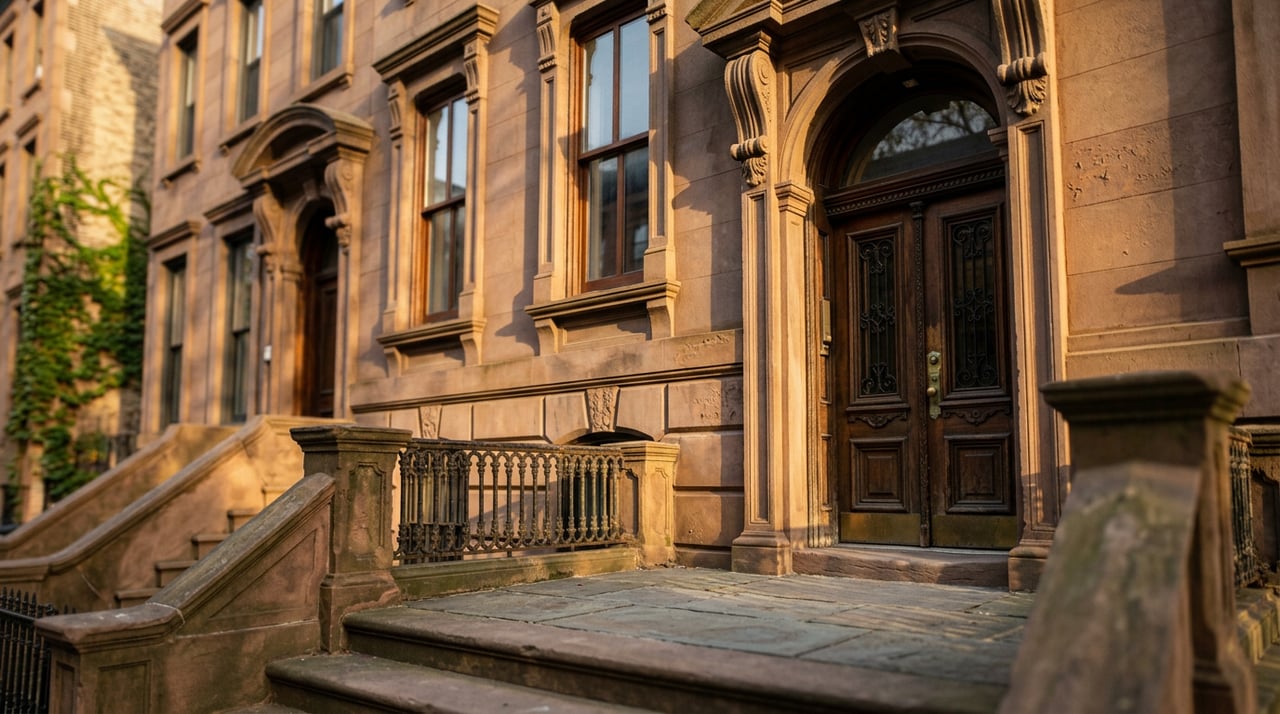
Buy a brownstone in Park Slope, Cobble Hill, or Fort Greene and someone will tell you the same thing before you've unpacked a single box: landmark status means a years-long fight with a preservation board before you can touch a window. Most buyers plan their renovation budget around that fear. It's the wrong fear.
The Landmarks Preservation Commission's own published guidance says 95% of its permit approvals happen at staff level, without a public hearing or a Commission vote at all. For most brownstone work, the process is faster than its reputation. The part that actually stalls projects is narrower, more specific, and tied to a calendar quirk almost nobody budgets around until it costs them a season.
The Three Lanes, and Which One You're Actually In
The LPC sorts every application into one of three tracks, and the track determines everything else about your timeline.
| Permit type | Covers | Typical review |
|---|---|---|
| Permit for Minor Work (PMW) | Smaller exterior changes that don't need a Department of Buildings permit, like in-kind window or door replacement | LPC targets about 10 business days for complete applications, with a legal decision deadline of 20 business days |
| Certificate of No Effect (CNE) | Work that requires a DOB permit but doesn't touch protected exterior features, including plumbing, heating equipment, and interior renovations that trigger a DOB filing | LPC targets about 10 business days, with a legal deadline of 30 business days once the application is complete |
| Certificate of Appropriateness (CofA) | Major alterations: additions, visible facade changes, rooftop work, anything that changes what the street sees | A full public hearing process, with LPC required to rule within 90 working days of a complete application, though real timelines commonly run closer to three months |
Most brownstone renovations, a kitchen gut, a bathroom overhaul, a boiler swap, a rear addition that doesn't change the street-facing elevation, fall into the first two lanes. They don't go before the Commission. A staff preservationist reviews the application through Portico, the LPC's online filing system, and issues a determination. This is the quiet majority of what actually happens inside Brooklyn Heights, Boerum Hill, Carroll Gardens, and every other landmarked stretch of Brownstone Brooklyn.
The CofA lane is the one people picture when they hear "landmarks board." It's real, and it's slow by design, but it's also the exception. It exists for the work that changes what a passerby on the sidewalk actually sees.
The Six Weeks That Break the Math
Here's the part the fast-lane statistics don't capture. If your project does need a Certificate of Appropriateness, it has to pass through your local Community Board before it ever reaches an LPC hearing. Brooklyn Community Board 2, which covers 10 of Brooklyn's 41 historic districts including Brooklyn Heights, states plainly that its Land Use Committee reviews applications on the third Wednesday of the month from September through June, and that the board does not review private residential applications in July or August.
That's not a minor scheduling note. If your architect submits a CofA package for a rear extension or a rooftop addition in late June, the community board step of your review doesn't happen until September at the earliest. Add that to the three-month LPC hearing clock and a project that looked like a spring completion becomes a fall one, purely because of when the paperwork landed on a calendar nobody checked first.
Brooklyn Heights has carried this kind of scrutiny longer than anywhere else in the city. It became New York's first designated historic district in November 1965, and the review structure that grew up around it, community board first, then LPC, has barely changed since. Anyone buying into that block-by-block character should plan the renovation calendar with the same seriousness as the budget.
What Changed This Year
The city has been trying to loosen this exact bottleneck, and the timing lands squarely in the middle of this year's renovation season. In June 2026, Mayor Mamdani's administration rolled out a set of tools as part of its Block by Block housing plan aimed specifically at smaller property owners inside historic districts. The package includes a new interactive map showing where Accessory Dwelling Units can be built within the city's 157 historic districts and extensions, a dedicated LPC team to help property owners navigate approvals, and new guidance on Landmark Transferable Development Rights, which let owners of landmarked buildings sell unused development rights to generate revenue for maintaining their properties.
LPC Chair Lisa Kersavage framed the goal directly: the tools are meant to help homeowners take advantage of new zoning opportunities, whether by adding an ADU for extended family or rental income, or by using landmark transfers to fund the upkeep of a historic building. The city is also advancing proposed rules that would expand the range of projects eligible for staff-level approval, which would shrink the slice of work that ever needs a public hearing at all.
Worth knowing before you plan around it: backyard ADUs are still prohibited in historic districts. The eligible categories are converted cellars, attics, and garages, which matters if your renovation plan for a Cobble Hill or Fort Greene brownstone includes rental income from an accessory unit.
The Line Items Beyond the Calendar
Timeline risk is only half the budget conversation. Landmarked work in Brooklyn carries a real cost premium, typically 15 to 25% above a comparable non-landmarked renovation, driven by the historically accurate materials the LPC requires, custom wood windows instead of off-the-shelf units, matched masonry instead of standard repointing. LPC filing preparation alone commonly adds $2,000 to $8,000 in fees and four to twelve weeks to a schedule before construction even starts. And because most Brooklyn brownstones are 110 to 160 years old, a full mechanical, electrical, and plumbing overhaul, often unavoidable once walls open up, commonly runs 25 to 35% of the total renovation budget on its own.
Those numbers matter more than they might seem, because Brownstone Brooklyn's pricing doesn't sit still while a renovation stalls. The borough's own brownstone matrix showed a median sale price of $3.375 million and an average of $2,231 per square foot in the third quarter of 2025, then $3.1 million and $1,665 per square foot by the fourth quarter. A market that moves that much in one quarter is not a market where a renovation delayed by a missed community board window is a cosmetic problem. It's a carrying-cost problem, and increasingly, a resale-comp problem too.
A Few Questions Worth Asking Before You Submit
Is my brownstone automatically landmarked because of its age? No. Age alone doesn't trigger LPC jurisdiction. The building has to sit inside a designated historic district or carry an individual landmark designation, which you can confirm through the LPC's own Discover NYC Landmarks map before you finalize any renovation design.
Does interior work need Landmarks approval? In almost all cases, no. LPC review is triggered by exterior changes visible from the street, plus a small number of interior renovations that also require a Department of Buildings permit. Interior gut renovations with no exterior impact typically only need standard DOB permits.
What if the previous owner already did unpermitted exterior work? LPC has a legalization process for after-the-fact applications, but they're reviewed more strictly than a standard filing and can require reversing the work. If you're buying a brownstone with visible exterior changes that look recent, it's worth confirming they were actually approved before you close.
A brownstone's landmark status isn't a warning label. It's a feature that has held Brooklyn's most character-rich blocks together for sixty years, and one that the city is actively working to make more workable for the people who actually live in these houses. Knowing which lane your project falls into, and which months to avoid submitting in, is the difference between a renovation that finishes on schedule and one that quietly loses a season to a calendar nobody read closely enough.
If you're weighing a landmarked brownstone in Brooklyn, or trying to figure out what a renovation timeline actually looks like before you write an offer, The Jane Advisory can walk through the specific building, district, and calendar with you. Connect with Jane.